

If you work in education, you already know the weight of high expectations. You are tasked with covering more content, meeting diverse needs, managing behaviors, and preparing students for the future, all within limited time.
It can feel impossible to do everything well.
But research shows that some habits and skills have a much greater impact than others. By helping students build just one or two of these high-impact habits, you can improve their learning, resilience, and confidence across all subjects.
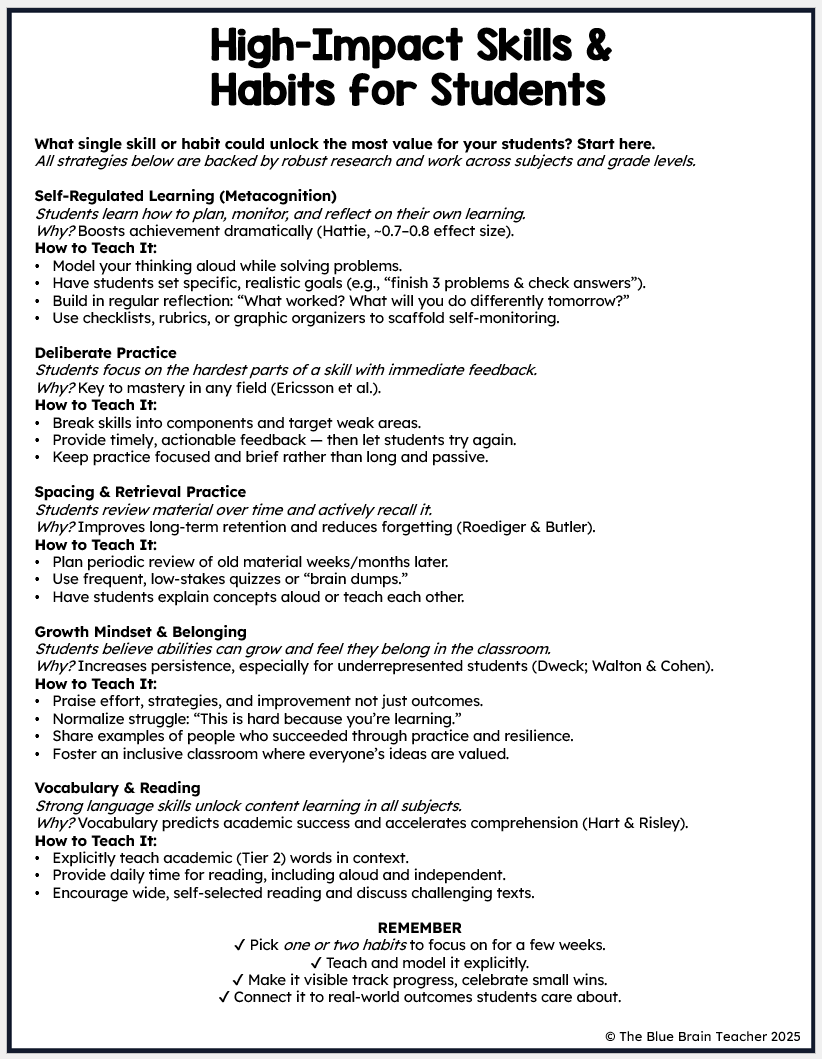
This free one-page cheat sheet, High-Impact Skills & Habits for Students, gives you clear, practical strategies backed by research.
Why Focus on One Skill or Habit?
When students struggle, it is often because of how they approach learning, not just what they know. Some students lack the tools to manage their learning, stay motivated, or practice effectively.
Decades of research show that certain habits help students succeed in any classroom:
- Students who reflect on and monitor their learning (metacognition) achieve at much higher levels.
- Students who practice deliberately, focusing on weaknesses with feedback, improve more quickly.
- Students who regularly recall and review material retain it longer.
- Students who believe they belong and can improve persist through challenges.
- Students with stronger reading and vocabulary skills perform better across all subjects.
By focusing on one or two of these areas at a time, you can help students build meaningful skills without adding to your workload.
What’s in the Cheat Sheet?
This free download summarizes the most impactful habits and explains why they matter. It also includes simple classroom strategies you can start using right away.
You do not need to redesign your curriculum or add more to your plate. You just need to embed these practices intentionally and consistently.
How to Get Started
- Download the High-Impact Skills & Habits for Students cheat sheet.
- Pick one habit to emphasize over the next few weeks.
- Teach it explicitly, model it, and track students’ progress.
- Connect the habit to real-world outcomes so students see its value.
Helping students build these habits equips them to take ownership of their learning and succeed beyond your classroom.
References and Further Reading
-
Ericsson, K. A., Krampe, R. T., & Tesch-Römer, C. (1993). The role of deliberate practice in the acquisition of expert performance. Psychological Review, 100(3), 363–406.
-
Hattie, J. (2009). Visible Learning: A synthesis of over 800 meta-analyses relating to achievement. Routledge.
-
Hart, B., & Risley, T. R. (1995). Meaningful differences in the everyday experience of young American children. Paul H Brookes Publishing.
-
Roediger, H. L., & Butler, A. C. (2011). The critical role of retrieval practice in long-term retention. Trends in Cognitive Sciences, 15(1), 20–27.
-
Walton, G. M., & Cohen, G. L. (2011). A brief social-belonging intervention improves academic and health outcomes of minority students. Science, 331(6023), 1447–1451.
-
Yeager, D. S., & Dweck, C. S. (2012). Mindsets that promote resilience: When students believe that personal characteristics can be developed. Educational Psychologist, 47(4), 302–314.



Leave A Comment