

Metacognition, often described as “thinking about thinking,” plays a crucial role in education and personal development. It encompasses the awareness of one’s own cognitive processes and the ability to regulate those processes to improve learning and problem-solving. Metacognition empowers learners by helping them assess their understanding, plan their approaches to tasks, and monitor their progress. Recent research highlights the importance of metacognition as a predictor of academic success, especially during early childhood development.
What is Metacognition?
Metacognition refers to the self-awareness and control of one’s own thought processes. It includes two core components: awareness (being conscious of one’s cognitive processes) and regulation (controlling and adjusting those processes). This skill enables individuals to reflect on their learning strategies, ask questions like “Do I understand this?” or “What could I do differently to solve this problem?” and make adjustments accordingly.
Research suggests that metacognition starts developing early in life. By age 3, children begin to exhibit basic metacognitive abilities, such as being able to reflect on their thought processes. Around age 4, they start evaluating their competence, which lays the foundation for more complex metacognitive behaviors as they grow older.
Metacognitive Skills and Learning Success
Metacognitive skills are essential for guiding how students learn, not only in school but in life. These skills can be broken down into three main processes:
These skills are key to effective problem-solving and academic achievement. For example, when students face a challenging assignment, their ability to plan a strategy, monitor their work, and evaluate their success determines how well they can navigate the challenge. Metacognition enables them to become more self-sufficient learners who can adapt their strategies to different situations.
The Role of Metacognition in Academic Success
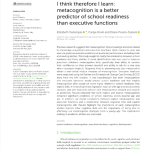
A growing body of research shows that metacognition is a critical predictor of academic success. In fact, a recent study by Dutemple, Brokl, and Poulin-Dubois (2024) found that metacognition is a stronger predictor of school readiness than executive functions. The study, titled I Think Therefore I Learn: Metacognition is a Better Predictor of School Readiness than Executive Functions, examined preschoolers’ metacognitive and executive function skills to determine which better predicted school readiness.
The researchers used visual identification tasks to assess metacognitive abilities and traditional tests to measure executive functions such as working memory and task-shifting. Their findings revealed that both implicit (automatic) and explicit (conscious) metacognition significantly predicted school readiness, while executive functions had no direct relationship with readiness. These findings suggest that fostering metacognitive skills in young children can have a profound impact on their ability to succeed in school, even more so than the development of executive functions like goal-setting and impulse control.
Effective Strategies to Foster Metacognition
There are various strategies that educators and parents can use to cultivate metacognitive skills in children. One proven method is reciprocal teaching, where teachers and students take turns leading discussions about the material being learned. This method encourages students to reflect on their understanding, ask questions, and evaluate their strategies, promoting self-awareness and deeper learning.
Research has shown that students taught using reciprocal teaching display significantly higher levels of metacognitive behavior compared to those taught using more traditional methods. This strategy helps young learners practice self-reflection and active thinking, which are essential components of metacognitive development.
Other strategies to promote metacognition include:
Self-checks
Encouraging students to pause and assess their understanding during tasks.
Physical education
Activities that require strategic thinking, planning, and reflection, such as team sports, can enhance metacognitive skills.
Convergent and divergent teaching styles
Engaging students in problem-solving activities that require both single-solution (convergent) and open-ended (divergent) thinking promotes flexible and adaptive learning strategies.
How Parents and Educators Can Support Metacognitive Development
Both educators and parents play a critical role in nurturing metacognitive development in children. Creating an environment that encourages self-reflection, open communication, and problem-solving is essential for fostering these skills.
For educators, this can be as simple as prompting students to think aloud while solving problems or encouraging them to evaluate their learning strategies. For parents, fostering metacognition might involve asking questions like, “What did you find difficult about that task?” or “How did you decide to approach this problem?” These questions encourage children to think about their thought processes and improve their ability to monitor and regulate their learning.
Moreover, collaborative efforts between educators and families can significantly enhance metacognitive development. By working together, parents and teachers can provide consistent support and reinforce metacognitive practices at both school and home.
The Importance of a Supportive Environment
A supportive environment is key to developing metacognitive skills. This environment should:
- Encourage reflection: Give children opportunities to think about their learning processes and outcomes.
- Promote peer feedback: Facilitate discussions and collaborative activities where children can learn from each other’s strategies and perspectives.
- Foster safe communication: Create a space where children feel comfortable expressing their thoughts and ideas without fear of judgment.
Such an environment allows children to experiment with different strategies, reflect on their successes and challenges, and ultimately become more effective learners.
Metacognition is a powerful tool that enables learners to take control of their own learning processes. As research has shown, metacognitive skills are not only essential for academic success but also for school readiness, often predicting success more effectively than traditional cognitive measures like executive functions. By fostering metacognitive awareness early in life, through strategies like reciprocal teaching and reflective questioning, parents and educators can help children develop into more effective, independent learners. Understanding how we think is the first step in learning how to learn—a skill that benefits individuals throughout their lives.
By placing metacognition at the heart of educational strategies, we can better equip students to navigate the challenges of learning and achieve greater success both in and out of the classroom.
Reference:
Dutemple, E., Brokl, C., & Poulin-Dubois, D. (2024). I think therefore I learn: Metacognition is a better predictor of school readiness than executive functions. Frontiers in Developmental Psychology, 2:1332358. https://doi.org/10.3389/fdpys.2024.1332358



Leave A Comment