
Too often, instructional playlists become well organized content libraries. Clean. Searchable. Comprehensive.
And shallow.
They hold videos, readings, and worksheets, yet they do not reflect how learning actually develops.
When students struggle, it is rarely because they lacked exposure. Exposure alone does not build understanding, confidence, or transfer.
If playlists are going to matter, they must function as learning pathways.
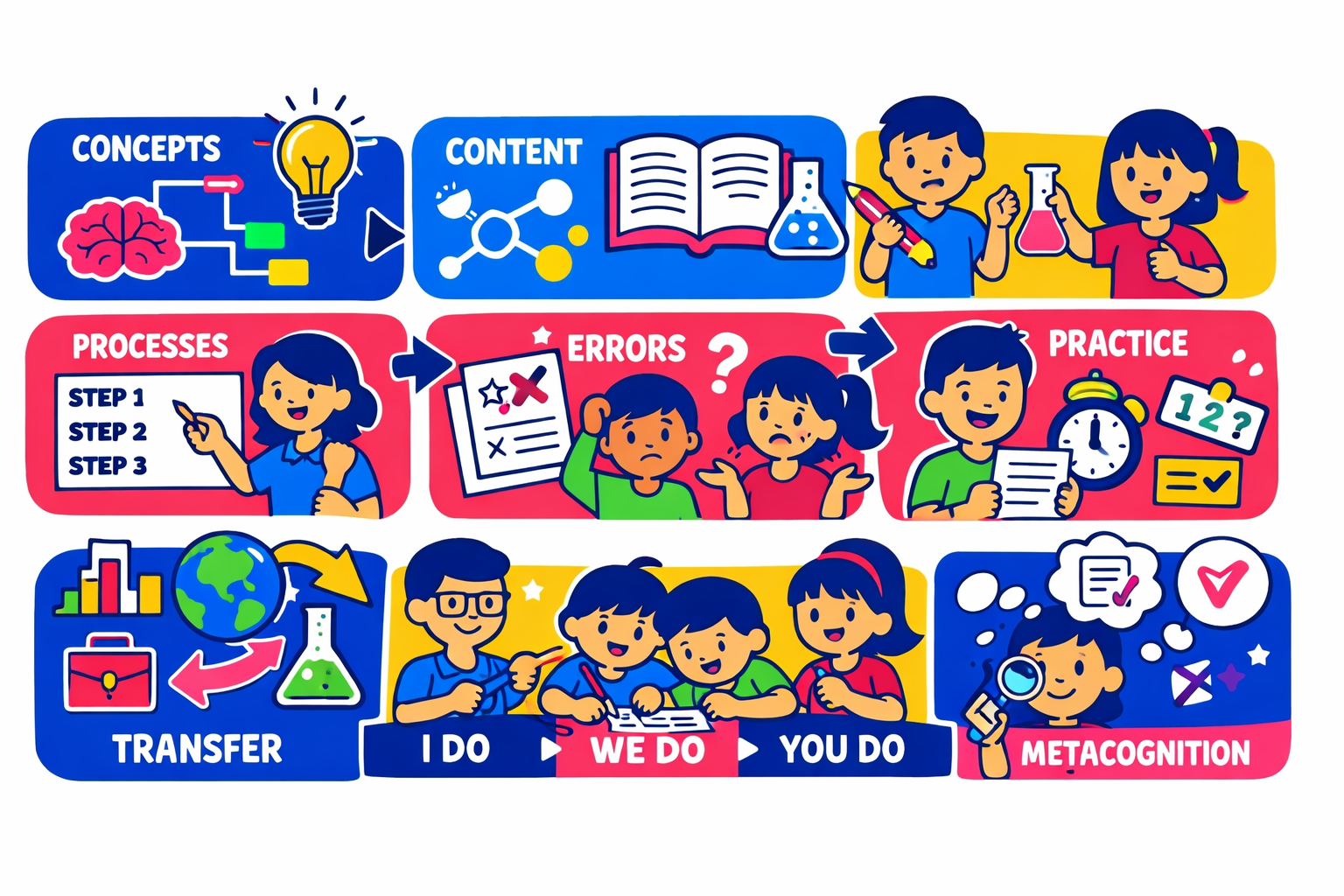
Below is a structure grounded in how students build competence over time.
Concepts
Before procedures and practice, students need structure.
Concepts answer:
- What is the big idea?
- Why does this matter?
- How does this connect to other learning?
When students memorize steps without understanding underlying structure, knowledge becomes fragile. Performance drops when the context changes.
Examples:
- In math, understanding function as a relationship.
- In history, analyzing cause and consequence.
- In science, recognizing systems and interactions.
A strong playlist makes conceptual architecture visible through:
- Core principles
- Essential questions
- Concept maps
- Cross-unit connections
Concepts create coherence.
Content
Students need vocabulary, background knowledge, definitions, and formulas.
Content should be organized around conceptual anchors.
For example, a photosynthesis sequence might include:
- Big idea, energy transformation in living systems
- Key vocabulary
- Foundational knowledge
- Visual models
Content builds the knowledge base that supports deeper understanding.
Skills
Skills translate knowledge into performance.
Examples:
- Solve linear equations
- Write a thesis statement
- Analyze primary sources
- Interpret data
Be precise about what students must be able to produce. Clarity improves instruction and feedback.
Processes
Students gain confidence when they see how experts approach tasks.
Processes include:
- Step by step problem solving models
- Writing frameworks
- Scientific method breakdowns
- Think aloud demonstrations
Show students:
- How to unpack a word problem
- How to annotate a dense passage
- How to select variables in an experiment
Visible thinking reduces cognitive overload and builds direction.
Errors
Students need explicit instruction on common mistakes.
High performing learners:
- Anticipate misconceptions
- Recognize errors quickly
- Apply correction strategies
Playlists should include:
- Common pitfalls
- Annotated incorrect examples
- Error analysis tasks
- Reflection prompts
Examples:
- Misapplication of distribution in algebra
- Essays that drift from the thesis
- Confusing correlation with causation
Error analysis strengthens retention and resilience.
Practice
Durable learning requires retrieval.
Effective playlists include:
- Practice problems
- Spaced review
- Mixed problem sets
- Self testing prompts
- Gradual release
Gradual release typically follows:
- I do, fully worked examples
- We do, guided practice
- You do, independent application
Support decreases as competence increases.
Practice should appear throughout the playlist.
Transfer
Students need opportunities to apply knowledge in new contexts.
Transfer includes:
- Real world applications
- Cross disciplinary connections
- Increasing complexity
- Novel problem types
Examples:
- Proportional reasoning in cooking and scale models
- Argumentative writing in science reports
- Historical analysis applied to modern civic issues
Transfer signals that knowledge is usable.
Metacognition
Metacognition builds independence.
Students should learn:
- How to check understanding
- How to study effectively
- What to do when stuck
- How to analyze errors
Include:
- Self assessment checklists
- Reflection prompts
- Structured study guidance
This strengthens academic self efficacy and ownership.
A Planning Structure for Schools
For staff planning, the structure can be summarized as:
- Concepts
- Content
- Skills
- Processes
- Errors
- Practice
- Transfer
- Metacognition
When units follow a consistent cognitive architecture, students begin to internalize how learning works.
Over time, they develop competence and independence across subjects.
If playlists are going to drive achievement, they must be designed with cognitive development in mind. Structure shapes learning.


Leave A Comment