

Visualizing Like Elon Musk
Creative visualization is more than just imagining what the future could look like—it’s about vividly shaping that future through the power of your mind. The creative skill “Visualize it Richly & Colorfully” encourages not just seeing but experiencing with all five senses. By engaging sight, sound, touch, taste, and smell, we unlock deeper levels of creativity, memory retention, and connection to the ideas we’re working on.
This skill is grounded in the research of E. Paul Torrance and Tammy Safter, who highlighted the importance of multisensory visualization in creativity and education. When we visualize using our full sensory spectrum, we don’t just imagine—we experience, which deepens understanding and encourages innovative thinking.
How Visualization Enhances Learning and Creativity
In educational and creative contexts, the principle of “Visualize it Richly & Colorfully” serves as a powerful tool to enhance learning experiences and stimulate creativity. By engaging sensory and imaginative capacities, visualization can lead to deeper understanding, improved problem-solving, and enriched creative expression. Research supports these claims, providing a robust foundation for implementing this approach.
Enhanced Learning Experiences
Visualization techniques significantly enhance memory retention and comprehension by activating multiple sensory and cognitive pathways. Cognitive theories, such as Allan Paivio’s Dual Coding Theory, suggest that information encoded both visually and verbally is more easily retrieved and understood.
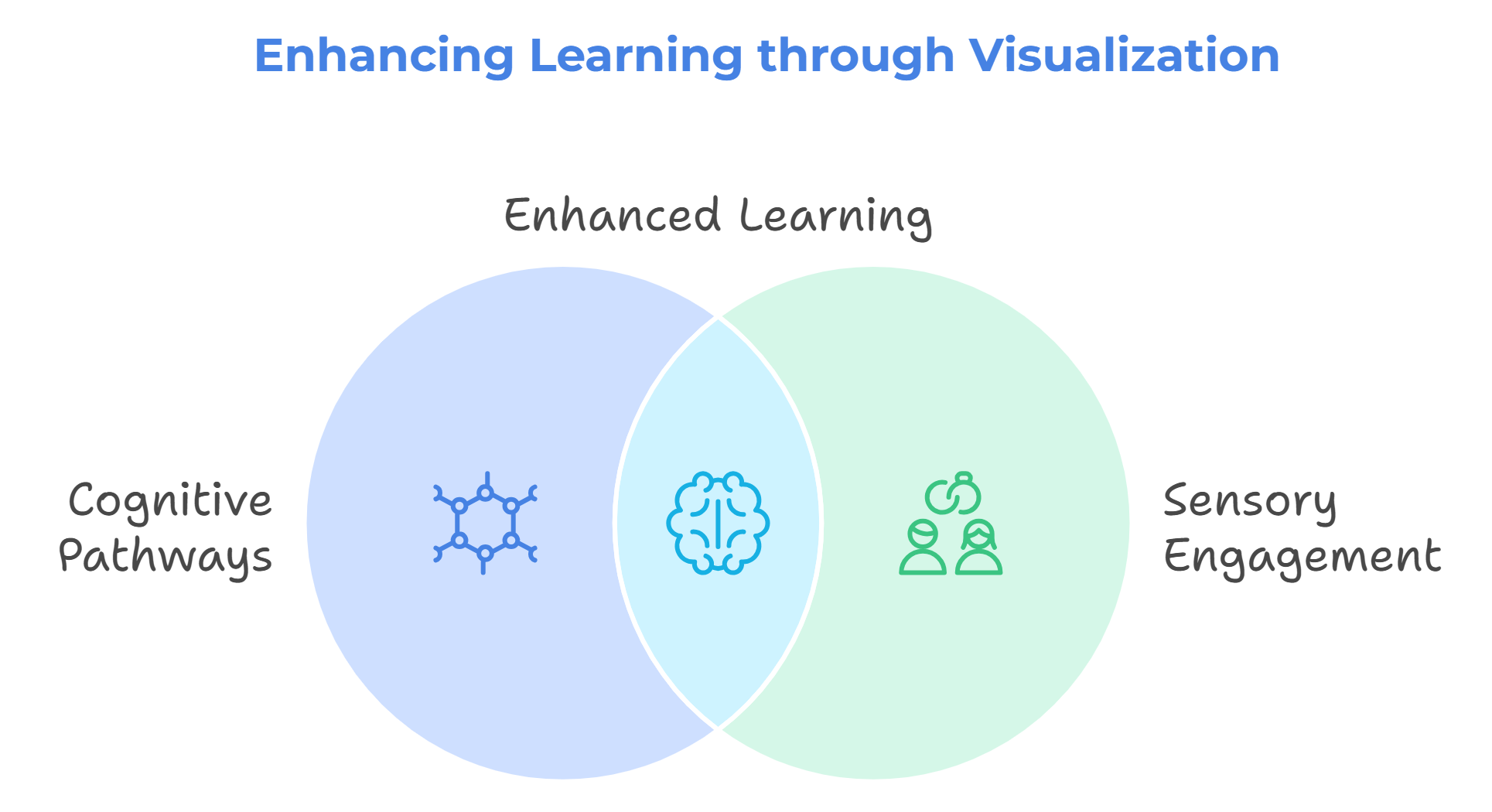
Encouraging students to create vivid mental images—incorporating not just visual elements but also sounds, textures, and smells—strengthens these dual pathways.
For example, students studying historical events can engage with “mental simulations” that integrate sensory details, fostering a more immersive and memorable experience. Research from neuroscience also shows that visual-spatial working memory is closely tied to academic achievement in subjects like mathematics and science, where the ability to visualize concepts plays a crucial role.
Creative Problem-Solving
Visualization is a cornerstone of creativity because it enables individuals to imagine possibilities beyond their immediate reality. The process of mental imagery—creating and manipulating images in the mind—stimulates the default mode network of the brain, which is linked to creativity and divergent thinking.
In creativity workshops or problem-solving sessions, guiding participants to visualize solutions multisensorily helps them generate innovative ideas. Studies indicate that visualizing scenarios in rich detail can aid in identifying non-obvious connections and exploring “what if” scenarios, critical for lateral thinking. Techniques like guided imagery or the “six senses method” (sight, sound, touch, taste, smell, and emotion) encourage a holistic exploration of ideas, resulting in more inventive outcomes.
Artistic and Literary Creation
Visualization fosters artistic and literary creativity by enabling creators to construct vivid, sensory-rich narratives or artworks. Embodied cognition research highlights how sensory details activate emotional and experiential memories, making creative outputs more engaging and relatable.
For writers, employing rich sensory language grounded in mental imagery can evoke strong emotional responses from readers, increasing engagement. Similarly, artists can enhance their work by visualizing not only the physical appearance of their subjects but also the sensory context—such as the texture of materials or the atmosphere of a scene. This practice aligns with findings in aesthetic psychology, where multisensory experiences often heighten an audience’s connection to creative works.
Personal Growth and Mindfulness
Visualization is also a potent tool for personal development, aiding mindfulness and emotional well-being. Techniques like guided meditation and sensory-rich visualization exercises are shown to reduce stress, enhance focus, and improve overall self-awareness. Paying attention to sensory details cultivates mindfulness by anchoring individuals in the present moment, which has been linked to increased resilience and reduced anxiety.
Visualization fosters a growth mindset. For instance, imagining oneself successfully completing a challenging task can bolster self-efficacy and motivation, as demonstrated by research on mental rehearsal in performance psychology.

Elon Musk: A Master of Rich Visualization
Elon Musk is a prime example of someone who uses creative visualization to fuel innovation. His ability to vividly imagine the future has guided the development of some of the world’s most groundbreaking technologies. Musk’s approach to visualization goes beyond simply imagining outcomes—he engages with every sensory detail to bring his visions to life.

Space Exploration with SpaceX
Musk’s vision for Mars colonization is a testament to his rich visualization skills. He didn’t just imagine the technical feasibility of space travel; he visualized entire colonies on Mars, including the habitats, transportation systems, and infrastructure needed to support human life. This vivid visualization has been instrumental in guiding the development of SpaceX’s Starship, designed to take humans to Mars.
Electric Vehicles with Tesla
In the realm of automotive innovation, Musk visualized electric vehicles that weren’t just environmentally friendly, but also superior in performance and aesthetics. Before Tesla cars existed, Musk had a clear image of their design, feel, and driving experience, which led to the creation of some of the most popular electric vehicles today.
Underground Transportation with The Boring Company
Musk’s vision for The Boring Company started with imagining high-speed underground transportation to solve urban congestion. He visualized a network of tunnels that would transform the way we commute. This visualization has already led to the development of the first test tunnel in Hawthorne, California.
Neuralink: Merging Technology with the Brain
With Neuralink, Musk has visualized a future where brain-computer interfaces revolutionize neurological treatments and human cognition. This vision has driven the creation of groundbreaking neural implant devices and surgical robots.
How You Can Visualize Like Elon Musk: 10 Strategies for Innovation
If you want to harness the power of visualization like Musk, here are 10 strategies to help you visualize creatively and effectively:
- Set Audacious Goals Start by setting big, bold goals that challenge the status quo. Musk’s goals are often monumental—like making life multi-planetary. Think about solving significant global problems.
- Think in First Principles Break down problems to their core components. This helps you understand the fundamental aspects of a problem and devise innovative solutions from the ground up.
- Engage All Your Senses When visualizing a solution, involve all your senses. Imagine what it looks like, sounds like, feels like, and even smells like. This multisensory approach enriches your vision and uncovers new insights.
- Iterate with Feedback Loops Regularly share your vision with others, gather feedback, and refine your ideas. This iterative process helps clarify your vision and make it more actionable.
- Embrace Cross-Disciplinary Learning Expand your knowledge across different fields. Musk’s success in various industries comes from his ability to integrate ideas from diverse disciplines.
- Practice Mental Simulation Regularly practice mentally simulating the realization of your vision. Mentally walk through each step, anticipate challenges, and refine your approach.
- Visualize Daily Make visualization a daily habit. Spend time each day imagining the future you want to create, paying attention to the details.
- Use Visual Aids Use tools like sketches, mood boards, and 3D models to help externalize and refine your vision. These visual aids help make abstract concepts concrete.
- Maintain Optimism Stay positive about your vision and the possibilities ahead. Optimism fuels creativity and persistence, essential for realizing ambitious goals.
- Embrace Failure as a Learning Tool View failure as an opportunity to learn and refine your vision. Like Musk, use setbacks as stepping stones to improve and move forward.
Visualizing a Future of Innovation
Elon Musk’s success can be attributed in large part to his ability to visualize richly and colorfully. By creating detailed mental images of the future, he has not only shaped his own projects but has inspired entire industries to think differently. Whether in space exploration, electric vehicles, or sustainable energy, his creative visualization process has allowed him to bring groundbreaking ideas to life.
By adopting similar strategies in your own life—setting ambitious goals, engaging all your senses in visualization, and embracing cross-disciplinary learning—you can enhance your creative problem-solving abilities and drive innovation. Visualization is not just about imagining the future; it’s about shaping it, and anyone can learn to do it.
Ready to unlock your students’ creative potential? Start incorporating rich visualization into your teaching today with our Creative Curriculum—a comprehensive resource designed to help educators foster innovation, critical thinking, and problem-solving in the classroom. Download it now and inspire your students to think outside the box and build a future full of possibilities!




Leave A Comment