


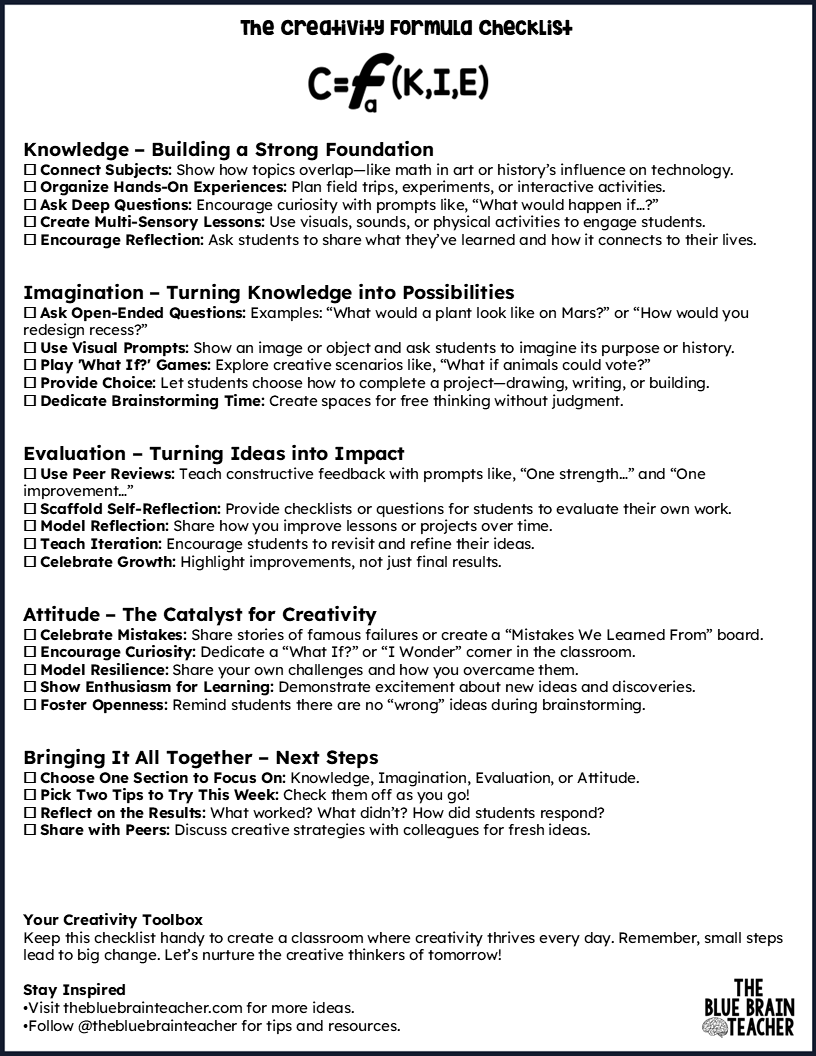
Creativity doesn’t just happen—it’s built. It’s nurtured. While students might have natural curiosity and imagination, creativity flourishes when they’re given the right tools, environment, and mindset. That’s where Ruth Noller’s creativity formula comes in: C = ƒa(KIE). It’s a simple way to break creativity into its essential parts—Knowledge, Imagination, Evaluation, and Attitude. Knowledge provides the foundation, Imagination sparks new ideas, Evaluation refines them, and Attitude fuels the process. Without a positive attitude, creativity can’t fully thrive.
In this post, I’ll show you how each piece of this formula works together to help students grow into confident, creative thinkers. By applying these strategies in your classroom, you’ll nurture students who can solve problems, think critically, and approach challenges with innovation.

Knowledge
You can’t connect the dots if there are no dots to begin with. Without a foundation of knowledge, students have little to work with. For example, many people might see a child’s artwork or invention and say, “Wow, little Johnny is so creative!” And they’re right—it’s a wonderful expression of creativity. But this type of creativity operates on a different level than groundbreaking innovations like Einstein’s theories or revolutionary inventions. High-level creativity demands more than imagination; it requires a depth of knowledge and expertise to draw meaningful connections.
Helping students build that foundation of knowledge is the first step. But it’s not just about memorizing facts. Knowledge becomes creative fuel when students really engage with what they’re learning. Instead of teaching science as isolated topics, connect the dots—show how ecosystems relate to weather, or how technology impacts the environment. Bring learning to life with field trips, hands-on experiments, and sensory-rich experiences. Even a walk around the schoolyard to observe the seasons can teach them as much as a textbook.
The more students know, the more connections they can make—and that’s where creativity starts. Understanding this is key: creativity exists on a spectrum. The depth and impact of a creative idea depend on the intellectual, experiential, and cultural resources someone can draw upon. I’ll dive deeper into this concept of creativity as a spectrum in a future blog post, but for now, the important takeaway is this: true innovation is as much about preparation (knowledge) as it is about inspiration.
Imagination
Imagination is where creativity takes shape—it’s the ability to look beyond what exists and explore what could be. It’s not just about coming up with something new; it’s about transforming what students already know into fresh possibilities.
In the classroom, fostering imagination means giving students the space and tools to explore and experiment:
- Ask big, open-ended questions. Shift from factual prompts like “What are the parts of a plant?” to creative ones like “What kind of plant could survive in a world without sunlight?”
- Encourage bold ideas. Projects like “How would you redesign the playground to make it accessible for everyone?” let students think ambitiously while putting their knowledge into action.
- Make brainstorming a judgment-free zone. Remind students that unconventional ideas often lead to the most innovative solutions. Create a classroom culture where no idea is too wild to explore.
Imagination thrives in an environment that celebrates curiosity and experimentation. When students feel free to think creatively, they start seeing challenges as opportunities to dream up new solutions.
Evaluation
Creativity isn’t just about coming up with ideas—it’s about turning those ideas into something meaningful. That’s where evaluation comes in. Students need to learn how to reflect on their work, refine their ideas, and decide which ones are worth pursuing. This part of the creative process doesn’t have to feel like criticism; instead, it’s an opportunity to grow.
Here are a few ways to introduce evaluation into your classroom:
- Peer reviews. Encourage students to share their projects and exchange constructive feedback. Not only does this teach collaboration, but it also helps them see their work from new perspectives.
- Self-reflection. After a project, guide students through questions like, “What worked well?” and “What would you do differently next time?” These reflections help them develop critical thinking and self-awareness.
- Modeling evaluation. Show students how you reflect on your own work. For example, you might say, “I thought this activity would work, but next time, I’d add more examples to make it clearer.” By modeling this, you’re teaching them that even adults revise and refine their ideas.
Evaluation helps students understand that creativity is a process—a cycle of imagining, testing, reflecting, and improving. It’s through this process that ideas grow into something truly impactful.
Attitude
In Noller’s formula, attitude is the secret ingredient. It’s what turns potential into possibility. A curious, open mindset doesn’t just elevate creativity—it amplifies everything else. The best part? Attitude is something you can shape and model every day, and it plays a critical role in every aspect of creativity.
- Attitude toward knowledge: Creativity starts with curiosity and a passion for learning. When you model excitement about discovering new things, your students will adopt the same enthusiasm. Help them see learning as an adventure, not a chore.
- Attitude in imagination: Imagination thrives on openness. Encourage your students to embrace possibilities, even if they seem unconventional or wild. When you show that there are no “wrong” ideas during brainstorming, they’ll feel freer to explore and experiment.
- Attitude in evaluation: Evaluation requires resilience and the ability to take constructive criticism. Show your students how to view feedback as an opportunity to grow rather than a personal failure. When you reflect on your own teaching and share what you’ve learned from mistakes, you’re modeling this mindset in action.
Your students will reflect the energy you bring into the classroom, so make it count:
- Celebrate mistakes. Frame them as steps toward growth. Share stories of famous failures that led to success.
- Foster curiosity. Create opportunities for “what if” questions and discussions. A curiosity board or journal can spark their interest in learning.
- Model resilience. Let your students see that persistence pays off. Share your own experiences with revising plans or trying new approaches until something worked.
Attitude is contagious. When you model curiosity, openness, and resilience, your students will learn to approach challenges with the same mindset. It’s this attitude that transforms creativity from a fleeting moment into a lifelong skill.
What About You? Reflecting on Your Own Creativity
Before you focus on nurturing creativity in your students, take a moment to reflect on your own. After all, creativity is something we model through our actions and attitudes every day.
When you reflect on your own creativity—your knowledge, imagination, evaluation, and attitude—you set the stage for your students to do the same. Leading by example shows them that creativity isn’t just something you do; it’s a mindset you carry into every part of life.
Let’s Shape the Innovators of Tomorrow
When you apply Noller’s formula, you’re equipping students with the skills to think boldly, solve real-world problems, and imagine new possibilities. Creativity is more than a natural talent—it’s a mindset that grows with the right guidance.
This formula helps you go beyond traditional teaching, fostering students who are curious, resilient, and imaginative. By building their knowledge, sparking their imagination, teaching them to refine ideas, and modeling a positive attitude, you’re preparing them to thrive in a world that depends on innovation and fresh perspectives.
The impact of your work doesn’t stop in the classroom. Your dedication lays the groundwork for future innovators and changemakers. It all starts with intentional steps—choose one element of the formula and explore how you can integrate it into your teaching this week.
Let’s continue the journey together! Download my free checklist, “The Creative Formula Checklist,“ and start bringing these strategies to life, step by step.
What part of the formula are you most excited to implement? Share your experiences in the comments—I’d love to hear what’s working for you and help with any challenges. For ongoing tips and inspiration, follow me for more creative teaching strategies. Together, we can empower the next generation of thinkers and dreamers!



Leave A Comment