
Some students do not forget because they are not trying. They forget because their brains are overloaded.
You have seen it before. A student hears directions, nods confidently, and then freezes. Another loses track halfway through a multi-step math problem. A capable reader shuts down during comprehension questions. From the outside, it can look like inattention, lack of motivation, or defiance. But often, the real issue is working memory load.
Working memory is the mental system that temporarily holds and manipulates information. It allows students to remember directions long enough to act on them, keep numbers in mind while solving a problem, or hold the beginning of a sentence in mind while reading the end. The catch is that it has limited capacity. When that capacity is exceeded, performance does not drop gradually. It collapses.
The good news: working memory can be strengthened with structured practice. And one of the simplest tools for doing that is the working memory task card.
What Working Memory Actually Does in the Classroom
Working memory is not just a psychology term. It is active in nearly every academic task a student performs.
It is what allows a student to follow multi-step instructions without losing the thread, hold a number in mind while regrouping in mental math, keep the beginning of a sentence in view while decoding the end, write while simultaneously remembering what they planned to say, and switch between tasks without losing their place entirely.
What makes working memory particularly demanding is that it requires both storage and processing at the same time. A student must hold information while simultaneously doing something with it. In mental math, for example, a student might hold the numbers 27 and 18 in mind while regrouping and calculating. If either the storage or the processing demand exceeds capacity, the system does not partially fail. The student often loses the thread entirely.
Understanding this distinction changes how we respond to these students. It shifts the focus from behavior management to cognitive support.
Why “Try Harder” Does Not Work
When a student forgets directions, the instinctive adult response is often to repeat the instructions more firmly, add a consequence, or attribute the lapse to inattention or poor attitude. But when cognitive load exceeds working memory capacity, pressure does not help. It increases stress, which further reduces the mental resources available.
This is a cognitive load problem, not a compliance problem. When demands exceed capacity, accuracy drops, frustration increases, avoidance behaviors emerge, and task persistence decreases. None of those outcomes are improved by raising your voice or increasing the stakes. Skill deficits require structured practice, not increased volume or consequences.
The Intervention: Working Memory Task Cards
Working memory task cards are simple in format but cognitively demanding in the right way.
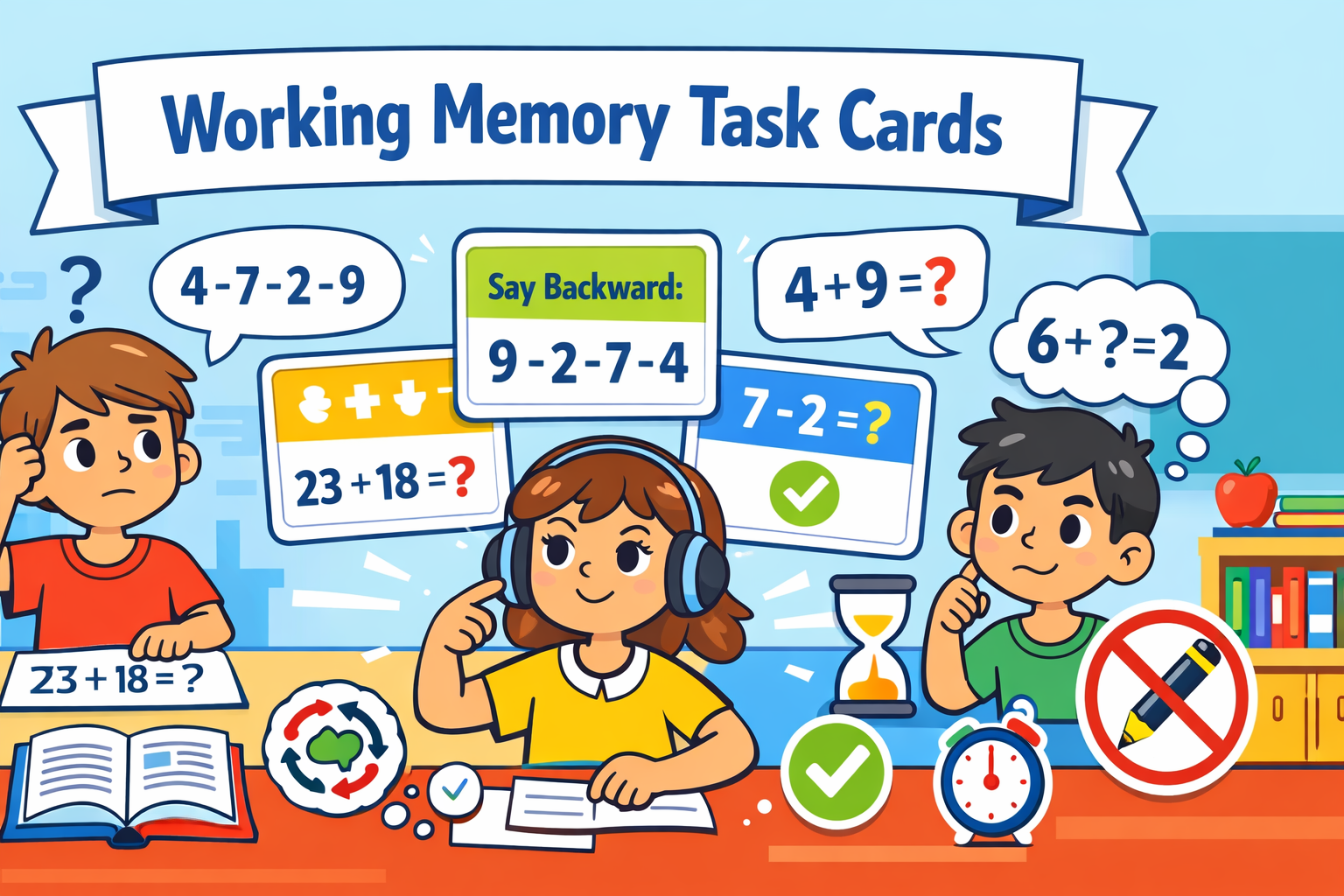
A typical task works like this. The student hears a number sequence read aloud once: for example, 4, 9, 2, 7. Without writing anything down, they must then perform a mental operation on it, such as repeating the numbers in reverse order, adding the first and last number, or subtracting the second number from the third.
No paper. No notes. No visual supports.
That constraint is precisely what makes the activity effective. It forces the student to retain information mentally, manipulate it under load, resist the impulse to write (which engages inhibitory control), sustain attention throughout, and build mental stamina through repetition. The activity is brief, focused, and cognitively intense in exactly the way that matters.
Why This Structure Works
The reason working memory task cards produce results is that they target multiple executive function processes at once, in a controlled and repeatable format.
A single task card simultaneously demands storage (holding the sequence), processing (performing operations mentally), updating (tracking changing information), inhibition (not writing or blurting prematurely), and error monitoring (self-correcting in real time). In many ways, it mirrors the cognitive load of real classroom tasks, but in a simplified and measurable form.
Rather than overwhelming students during academic work, we are isolating and strengthening the underlying system that academic work depends on. And because the format is short and trackable, progress is easy to monitor. Sequence length, operation complexity, and time constraints can all be adjusted gradually as capacity grows.
Who Benefits Most
Working memory task cards are particularly effective for students with ADHD, executive function weaknesses, slow processing speed, math calculation difficulties, or reading comprehension struggles. They are also well suited for students receiving Tier 2 or Tier 3 intervention support.
These students often appear inattentive or unmotivated. In most cases, the underlying issue is cognitive overload, not character. By targeting working memory directly, we reduce the strain that everyday academic tasks place on a system that is already working hard just to keep up.
How to Implement It Well
A few practical guidelines make the difference between an effective routine and one that fades out after a week.
Keep sessions short. Three to five minutes daily is the target. Consistency matters far more than duration. Start with four-digit sequences and progress gradually: four digits, then five, then six, then mixed operations, and finally mild time constraints once accuracy is strong. Track both accuracy and response time, as improvement in either is meaningful data.
Introduce the activity in small groups first so students can build confidence before working independently. And maintain the no-writing rule without exception. When students externalize the information onto paper, the cognitive load shifts away from memory and the intervention loses its purpose. The strain must stay internal. That is the point.
Done consistently and calmly, this becomes a mental workout students can feel themselves getting better at.
What Progress Looks Like
Working memory growth is gradual rather than dramatic. But over weeks of consistent practice, the signs tend to be noticeable: fewer forgotten steps in multi-part assignments, improved mental math fluency, better reading comprehension stamina, greater persistence on challenging tasks, and reduced avoidance behaviors.
It is important to frame this realistically with students and families. Working memory training is not a cure. It does not eliminate ADHD or resolve learning disabilities. What it does is strengthen a foundational system that supports academic performance across subjects. And small, genuine gains in working memory often produce disproportionate gains in confidence, which has its own momentum.
Mistakes Worth Avoiding
Even a well-designed intervention can lose effectiveness if implementation drifts. The most common pitfalls are increasing sequence length too quickly before accuracy is solid, allowing students to write responses, using the activity as a punishment or pressure tool, recycling identical formats without variation, and turning it into a competition that raises anxiety.
The tone throughout should be calm, focused, and growth-oriented. This is cognitive conditioning, not discipline.
The Bigger Picture
Research consistently links working memory to academic performance across reading comprehension, math achievement, written expression, and even classroom behavior. Crucially, executive function skills are malleable. They respond to structured, repeated practice in ways that other cognitive traits do not.
Working memory task cards work because they are short enough to be sustainable, targeted enough to be effective, and simple enough to be embedded into any daily routine without disrupting instruction. In education, there is a tendency to search for complex, resource-intensive solutions. But some of the most effective interventions are small, consistent cognitive challenges applied over time.
When a student forgets, the right question is not “Why aren’t they trying?” It is “Which system needs support?” Three to five minutes of intentional practice each day can reinforce the mental foundation that learning depends on.


Leave A Comment