
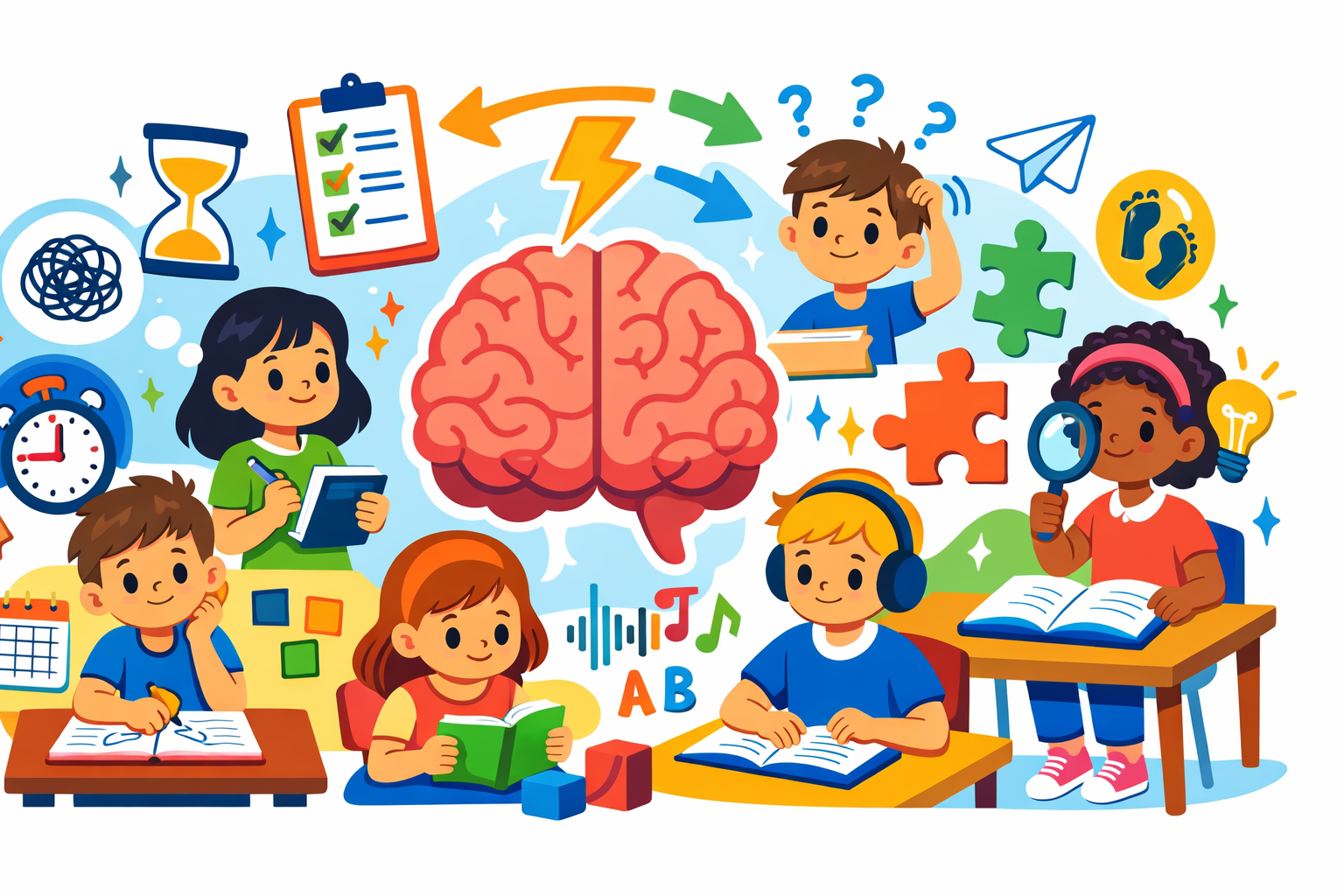
For decades, struggling students were labeled as “unmotivated,” “lazy,” or simply “not smart enough.” Today, research tells a very different story. The vast majority of students who struggle academically have average intelligence. What they experience instead are challenges in specific cognitive and self-regulatory systems that directly affect how they learn.
This distinction matters enormously. When we understand what is actually driving academic difficulty, we stop blaming effort and character, and start strengthening the skills that genuinely move the needle. Here are the six cognitive areas that research consistently links to learning difficulties, and why every educator and parent should know them.
Executive Function: The Brain’s Management System
Think of executive function as the brain’s air traffic control system. It governs a student’s ability to plan, focus, hold instructions in mind, and juggle multiple tasks at once. Core components include working memory, inhibitory control (resisting distractions and impulsive responses), cognitive flexibility, and planning and organization.
Research consistently shows that weak executive function predicts difficulties in math problem-solving, reading comprehension, and written expression. A student may understand a concept perfectly well and still struggle to organize their thoughts, follow multi-step directions, or submit work on time. In the classroom, these challenges often look like forgetfulness, incomplete tasks, or frustratingly inconsistent performance. The issue is rarely effort. It is the management system that coordinates effort.

Processing Speed: Keeping Up With the Pace of Learning
Processing speed refers to how quickly a student can take in information, make sense of it, and respond. Students who process more slowly may fall behind during lectures, need extra time to copy notes, or feel overwhelmed by timed assessments.
Here is what the research makes clear: slow processing speed is not the same as low intelligence. Many highly capable students simply process information deeply rather than quickly. The problem is that most classrooms are structured to reward speed over depth, which systematically disadvantages these learners. Studies show that when accommodations such as extended time are provided, performance often improves dramatically, revealing ability that time pressure had been masking all along.
Working Memory: The Mental Workspace
Working memory deserves particular attention because of its remarkably strong link to academic achievement. It is the cognitive system that allows students to hold information in mind while actively using it: following multi-step directions, performing mental math, connecting ideas across paragraphs, or keeping a question in mind while searching for an answer.
When working memory capacity is limited, students may lose track of instructions midway through a task or forget what they just read. The result often looks like carelessness or incomplete effort. In reality, their mental workspace has simply become overloaded. Research has found strong correlations between working memory capacity and performance in both math and reading comprehension, making it one of the most important cognitive targets for early identification and support.
Phonological Processing: The Foundation of Reading
One of the most well-established findings in all of educational research concerns phonological processing: the ability to recognize and manipulate the sounds within language. This includes identifying rhyming patterns, breaking words into syllables, isolating individual speech sounds (phonemes), and connecting those sounds to letters on a page.
In the vast majority of dyslexia cases, the core deficit is phonological, not visual, not motivational, and not related to intelligence. A student with strong reasoning skills may still struggle to decode words because their brain processes the sound structure of language differently. The encouraging part of this story is that the research is equally clear about the solution: structured literacy instruction and explicit, systematic phonics teaching significantly improve reading outcomes for these students.
Attention Regulation: Sustaining and Directing Focus
While attention regulation overlaps with executive function, it is worth examining on its own. The ability to sustain focus over time, filter out competing stimuli, persist through challenging work, and redirect attention when needed all play a direct role in how much a student can absorb and retain in a learning environment.
Students who struggle with attention regulation may begin tasks with genuine enthusiasm and still fail to complete them. Others may appear disengaged when they are actually overwhelmed by sensory and social stimulation in the room. Attention challenges are strongly associated with ADHD, but research also shows that many students without a formal diagnosis experience meaningful regulatory difficulties, particularly in high-stimulation settings like busy classrooms.
Metacognition: Knowing What You Know
Metacognition is the ability to think about your own thinking. It is what allows a student to ask: “Do I actually understand this?” “Why did I get that wrong?” “Is the strategy I am using working?” Research consistently shows that struggling learners tend to have inaccurate self-assessment. They may feel confident about material they have not truly mastered, or they may write themselves off entirely after a single setback.
Without metacognitive awareness, students rarely adjust their approach on their own. Teaching them to monitor their own comprehension, self-question during studying, and reflect on errors can produce significant gains in achievement. Practical strategies include exit tickets that ask students to rate their own understanding, think-aloud modeling during instruction, error analysis exercises, and study strategy reflection logs. When students develop metacognition, they shift from passive recipients of information to active managers of their own learning.
What the Research Does Not Support
It is just as important to name what the evidence does not show. Low intelligence, laziness, and poor character are not primary drivers of academic struggle. Research repeatedly finds that most students who underperform score within the average range on intelligence assessments. Their difficulties trace back to specific weaknesses in the cognitive systems described above, not to global ability deficits.
When educators shift the question from “Why isn’t this student trying?” to “Which cognitive system needs support?”, the entire intervention model changes.
Why This Matters
Understanding these six domains reframes how we respond to academic difficulty. We provide structured supports instead of consequences. We offer accommodations that remove barriers rather than lower standards. We teach strategy and skill alongside content. And we protect student confidence by treating struggle as a solvable problem rather than a character flaw.
The most powerful moment for many students is a simple realization: “I am not bad at school. My brain just works differently.” That shift alone can restore motivation in ways that pressure and punishment never could.
Supporting executive function, processing speed, working memory, phonological processing, attention regulation, and metacognition is not about giving students an advantage. It is about giving them access to the learning that was always within their reach.


Leave A Comment