

Ditch the AI Training Wheels
AI is reshaping education but how we choose to engage with it now will determine our role in that future. While a wave of preformatted education tools promise quick wins and time-saving shortcuts, there’s a deeper truth we can’t afford to ignore: true AI fluency comes from engaging directly with the source, large language models like ChatGPT, Claude, and Gemini.
If you’re an educator who wants to stay in education, stay relevant, and stay in charge, it’s time to skip the training wheels and take the wheel yourself.
The Comfort, and the Cost, of Prepackaged AI Tools
Skip the Subscriptions. Learn to Prompt.
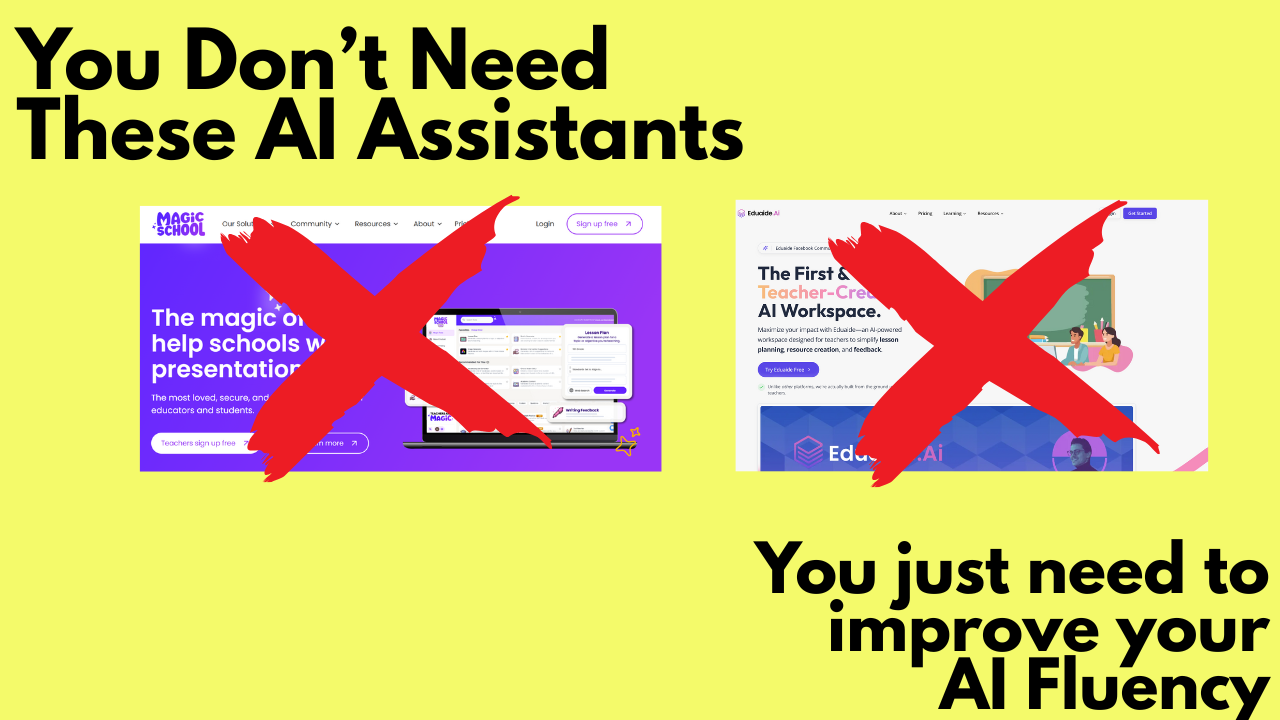
There’s no shortage of teacher-facing AI platforms like MagicSchool, Eduaide.ai, etc offering ready-made templates for lesson plans, rubrics, IEPs, and more. They seem like time-savers. Plug in a topic, click a few buttons, and out comes your resource.
But here’s the problem:
These tools don’t teach you how to think with AI.
They teach you how to watch AI perform behind someone else’s prompt.
You’re locked into their logic. You’re not driving the tool, just riding along. And when the interface changes or breaks, you’re left without the underlying skill.
This is a dangerous dependency during a technological shift where fluency matters more than convenience.
You don’t need a subscription to a prepackaged assistant.
What you need is prompt fluency—because that’s what you’ll soon be teaching students.
Understanding how to frame questions, iterate prompts, and evaluate outputs is the foundation of AI literacy. Templates won’t help when the task is nuanced or when you’re helping students troubleshoot their own AI use.
Skip the crutches. Use the actual LLMs: ChatGPT, Claude, Gemini directly.
Learn to prompt. Reflect. Iterate. Teach it forward.
“Relying on pre-built tools is like using a calculator without ever learning math.”
LLMs Like ChatGPT Are the Real Classroom Game-Changers
At the heart of nearly every AI tool is a large language model (LLM): ChatGPT, Claude, Gemini. These are the engines. The raw, adaptable brains that power everything from casual conversation to complex lesson design. And they’re available for you to use, directly and powerfully.
What makes LLMs better for teacher growth?
- They’re flexible. You’re not stuck with one format—create rubrics, simulate students, generate reflections, differentiate content, all from one place.
- They build fluency. The more you prompt, the more you learn. Prompting becomes a thinking tool.
- They put you in control. You decide what you need. You define the boundaries. You shape the interaction.
“If you can teach, you can prompt.”
Prompting Is Pedagogy
Prompt engineering may sound like a technical skill but for teachers, it’s not new. If you’ve ever:
- Designed a guiding question
- Scaffolded a lesson
- Given formative feedback
- Differentiated for learners
…you already understand the essence of prompting. You just haven’t applied it to AI yet.
This is why educators are uniquely positioned to lead the AI transition: we know how to ask better questions. That’s what prompt engineering really is.
Why Now Is the Time to Dive In
We’re still in the early days of the AI transition in education. This is the moment when:
- Habits are forming
- Tools are evolving
- Policies are being written
- Cultures of use are emerging
If we wait too long or lean too heavily on templated tools, we risk surrendering our professional agency to automation. But if we engage now deeply, critically, and creatively, we shape how AI fits into education, not the other way around.
“AI won’t replace teachers—but teachers who use AI well will redefine the profession.”
Your SUMMER PD Action Plan: Start with the Source
Here’s how you can start building real AI fluency today:
- Use ChatGPT or Claude regularly. Start with lesson ideas, then go deeper—feedback, simulations, student support.
- Practice prompt engineering. Reflect on what works. Treat it like lesson planning: iterative, reflective, adaptive.
- Build or join a community of practice. Share prompts, analyze outputs, talk ethics, and grow together.
- Avoid crutches. If a tool doesn’t teach you how it works, it’s not teaching you anything at all.
Educators Are the Innovators
We need tools that work with us. Engaging directly with LLMs gives us the agency, the flexibility, and the power to reshape education from the inside. We need to be pedagogically grounded and future-ready.
So if you’re still on the edge: jump in. The future of education needs teachers who know how to think with AI not just click through it with preformatted templates.



Leave A Comment