
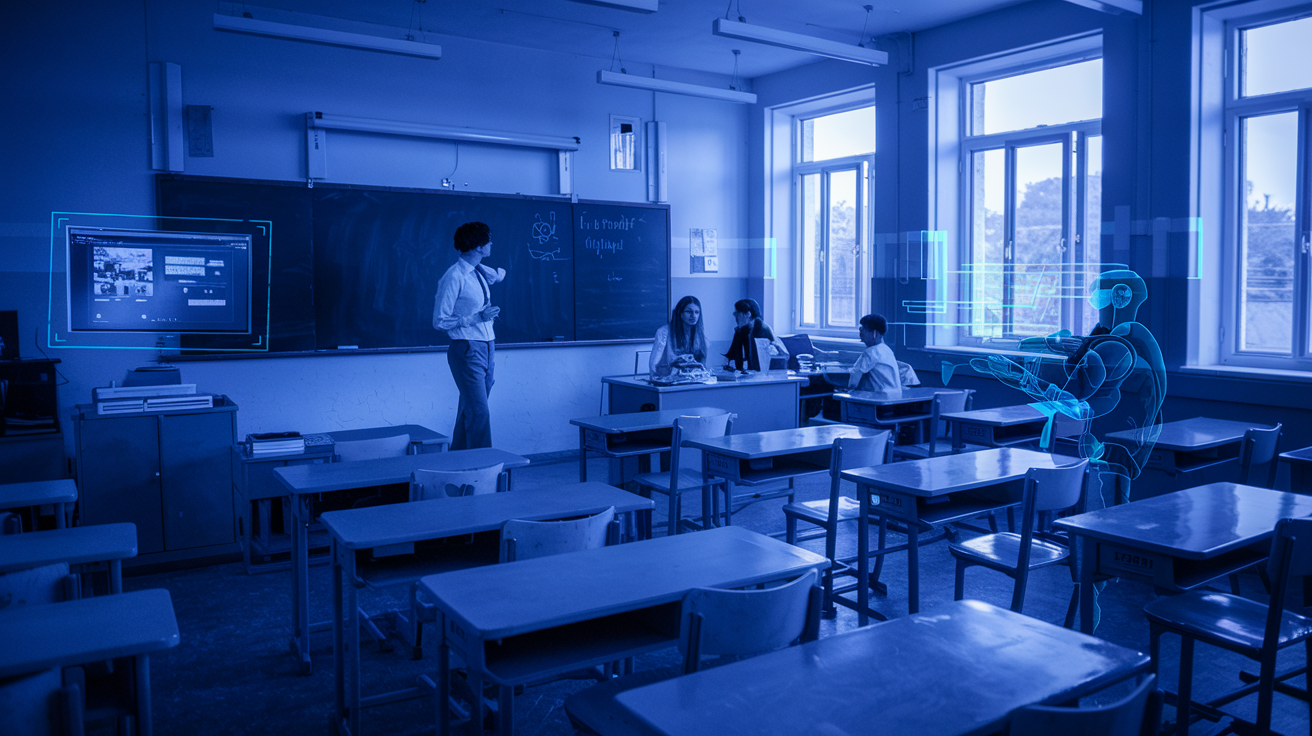
Unlike past tech waves, AI challenges what it means to think, learn, and teach. It’s a turning point, one that challenges the foundations of how we teach, what we value in learning, and how we prepare students for a world that’s evolving faster than our lesson plans. As AI tools like ChatGPT, AlphaEvolve, and autonomous agents move from novelty to norm, many of us in education are understandably concerned. Cheating, shortcuts, and academic dishonesty are real issues. But if that’s all we focus on, we’re missing the deeper disruption. This moment isn’t about managing technology. It’s about reimagining pedagogy.
AI Is Moving From Tool to Collaborator
For years, AI was something we “used” such calculators, spell check, grammar check, recommendation engines. But now, it’s stepping up. Consider Google DeepMind’s AlphaEvolve, which isn’t just crunching numbers. It’s solving advanced math problems and improving energy use in data centers finding solutions that have eluded experts for decades (Heaven, 2025).
This isn’t just automation. It’s initiative.
That shift from tool to actor means students won’t just need to operate AI. They’ll need to direct it, challenge it, and collaborate with it. That’s a leap far beyond “don’t cheat with ChatGPT.” It’s the difference between driving a car and designing one.
Cheating Isn’t the Crisis. Irrelevance Is.
Let’s be honest, the initial reaction from many schools was understandable. When AI started spitting out essays and solving math problems in seconds, the focus turned to surveillance, restrictions, and trying to catch students cutting corners.
But that’s missing the bigger picture. AI can now perform many of the tasks we once saw as the endpoint of learning. Writing summaries, generating code, analyzing patterns, these aren’t tests of human intelligence anymore. They’re baseline outputs for machines.
If our lessons still build toward those outputs, we’re not teaching thinking. We’re teaching delegation. And if students aren’t taught how to delegate wisely, they’ll do it blindly, or not at all.
Instead of doubling down on lockdown browsers and plagiarism checkers, we need to raise the ceiling. Ask better questions. Set harder problems. Reward original thinking, not perfect formatting.
Anticipating the AI-Driven Future
Industry leaders project significant advancements in AI capabilities in the near future. Sam Altman, CEO of OpenAI, predicts that AI agents will begin to autonomously perform digital tasks by 2025 . Eric Schmidt, former CEO of Google, foresees AI generating original scientific insights by 2026 and anticipates the integration of AI-powered robots into various industries by 2027 (In the Age of AI).
These projections underscore the necessity for education systems to prepare students for a dynamic landscape where adaptability and continuous learning are paramount. Students must be equipped not just with knowledge but with the skills to navigate and influence an AI-integrated world.
What Students Need: AI Fluency
It’s time to update the skillset. Being “AI literate” used to mean knowing what it is. Now, fluency means working alongside it. That includes:
- Judgment — knowing when to use AI and when to turn it off
- Ethics — wrestling with questions machines can’t answer
- Creativity — imagining what doesn’t yet exist
- Collaboration — working with humans and machines in real time
- Systems thinking — seeing how tech connects to culture, policy, and the planet
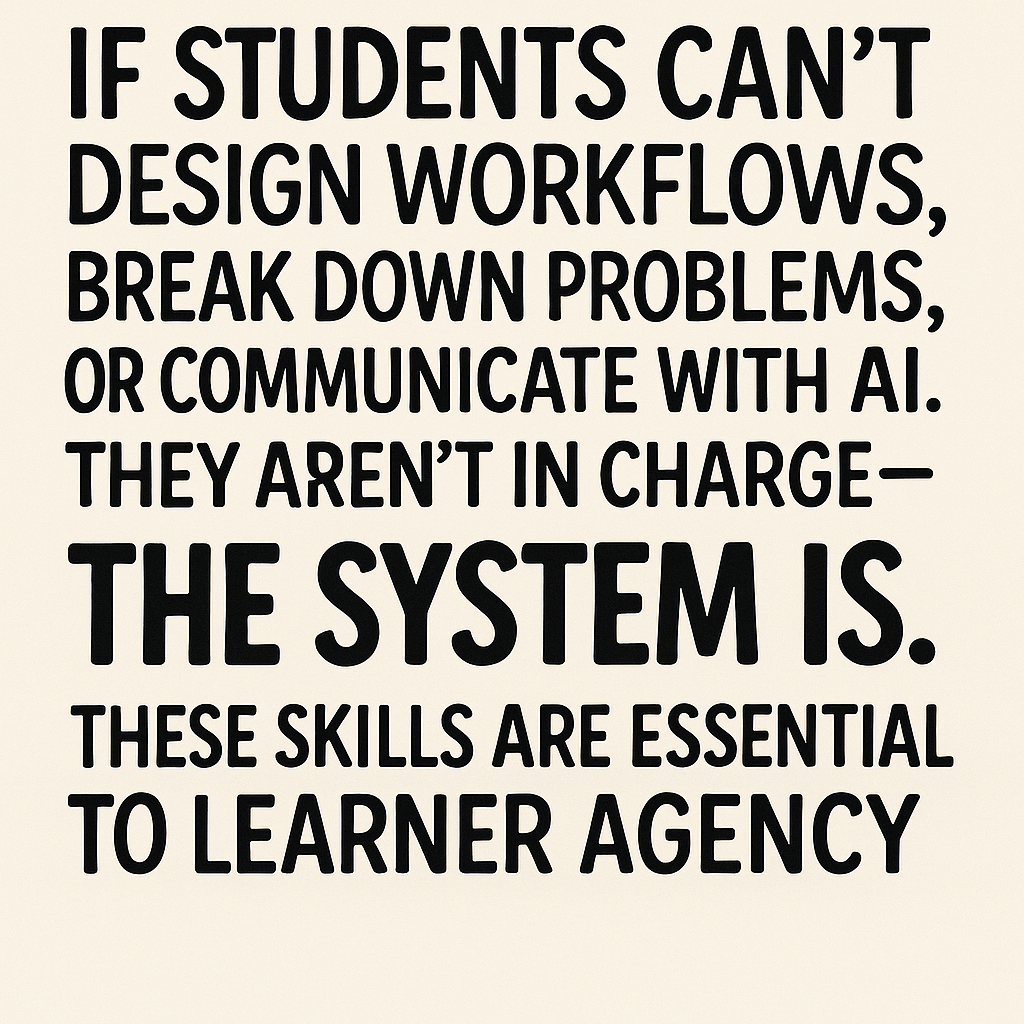
Also, let’s not tiptoe around it. Prompt engineering, workflow design, and task decomposition are becoming the new search skills. These shouldn’t be electives. They’re essentials.
Your Role Is Shifting from Content Expert to Cognitive Architect
As AI handles more routine tasks, the teacher’s role shifts:
- From gatekeeper of information → to guide for inquiry
- From monitor of output → to coach for process
- From answer-giver → to problem-framer
- From enforcer of compliance → to modeler of curiosity and discernment
This is the time to redefine our profession. But it demands retooling, support, and clarity of purpose.
What This Means for Individuals and Institutions
Whether you’re a student, worker, policymaker, or business leader, the implications of this transformation are real. But they are not uniform.
If you’re navigating your career, focus on:
- Hybrid skill sets: Pair domain expertise with AI fluency.
- AI orchestration: Learn how to design workflows that integrate AI effectively.
- Soft skills: Communication, ethics, adaptability, and complex problem-solving remain essential.
If you’re leading an institution, consider:
- Embedding AI literacy into education and training systems.
- Designing inclusive transition strategies for those impacted by automation.
- Investing in AI infrastructure that is accountable, transparent, and aligned with public values.
Final Thought: We are in the midst of a Pedagogical Crisis
The real question isn’t whether students will use AI. They already are. The real challenge is whether we understand it well enough to help them use it wisely. If we stay focused on cheating, content policing, or strict rubrics, we risk making ourselves less relevant. The world is shifting, whether we’re ready or not. There’s still time to respond. And educators still hold influence. But it will take a clear shift from reacting to rethinking, from fear to responsibility.
Heaven, W. D. (2025, May 15). Google DeepMind’s new AI agent cracks real-world problems better than humans can. MIT Technology Review. https://www.technologyreview.com/2025/05/14/1116438/google-deepminds-new-ai-uses-large-language-models-to-crack-real-world-problems/
In the Age of AI – A Panel Discussion with OpenAI CEO Sam Altman at TU Berlin. (n.d.). YouTube. https://www.youtube.com/live/McuO7Osgzqo



Leave A Comment