

What do you do when a student answers “Find x” by circling it and writing, “Here it is”? Is that creativity—or just a joke?
Too often, we mistake humor or unconventional answers for creative thinking. But real creativity isn’t just about coming up with wacky ideas—it’s about originality with purpose. And yes, it can be taught.
Let’s break down what creativity really means and how we can help students develop it in a way that goes beyond just being different.
The Confusion Around Creativity
Let’s start with a few examples of student answers that some might call “creative” but actually don’t meet the definition:
Example 1:
A math problem asks a student to find x. The student circles the variable and writes, “Here it is.”
Example 2:
A history question asks, “What ended in 1896?” The student confidently answers, “1895.”
Example 3:
A worksheet asks students to name different quadrilaterals. Instead of using mathematical terms like rectangle, square, and rhombus, the student names them Bob, Sam, Cate, and Harry.
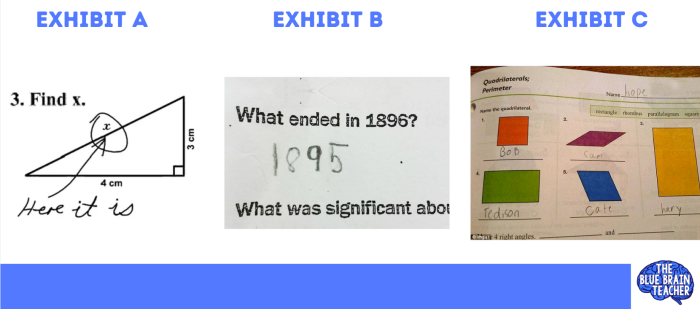
Are these responses funny? Absolutely. Are they creative? Not really.
What Is True Creativity?
To understand creativity in a way that actually helps us teach it, let’s look at two key formulas that break it down.
Formula 1: Beghetto & Kaufman’s Creativity Formula
C = [O x TA]Context
Where:
- O = Originality – The idea is new or unique.
- TA = Task Appropriateness – The idea makes sense and serves a purpose within the task.
- Context – Creativity is judged within a particular situation.
So, while naming a square “Harry” is technically an original response, it fails the task appropriateness test. The goal of the activity was to demonstrate knowledge of quadrilateral types, not to assign them human names. This means the response is more humorous than creative.
Formula 2: Noller’s Creativity Formula
C = ƒa(KIE)
Where:
- K = Knowledge – Understanding of the subject matter.
- I = Imagination – Thinking of new ideas.
- E = Evaluation – Assessing whether the idea is effective.
- A = Attitude – Willingness to take risks and refine ideas.
Looking at the example of “Find x” where the student simply points to the variable, we see an issue: There’s no evaluation of whether the answer meets the problem’s intent. The student is being playful but not demonstrating knowledge of solving for x.
So, How Do We Teach Creativity?
If we want to cultivate true creativity in students, we need to go beyond humor or unexpected answers. Here’s how:
1. Encourage Originality, But Anchor It in the Task
- Ask students to generate unique ideas while ensuring they align with the assignment. For example, if a student wants to redefine quadrilateral names, have them justify why they chose those names based on properties (e.g., “This one is Bob because it has all equal sides, making it a square, which is strong and balanced like Bob the Builder!”).
2. Teach That Creativity Has Context
- What’s creative in one situation isn’t in another. If a student says, “What ended in 1896? 1895!”—ask them to think deeper. What major events actually ended in 1896? Have them research and present an answer in a way that’s both original and historically accurate.
3. Focus on Process Over Product
- Creativity is about more than just coming up with something quirky—it’s about problem-solving and refinement. Encourage brainstorming, feedback, and iteration. If a student gives a joke answer, push them further: “Great joke! Now, can you also think of a creative way to truly answer the question?”
4. Create a Safe Space for Risk-Taking
- Students need to feel safe to try new things without fear of being “wrong.” However, they also need to learn that creative thinking requires effort. Being creative isn’t just about answering in unexpected ways—it’s about applying knowledge in new and meaningful ways.
Conclusion: Creativity Is More Than Just a Clever Answer
Creativity isn’t just about being different—it’s about being both original and effective. By using structured approaches to creativity, we can help students move beyond surface-level humor and develop real, impactful creative thinking skills.
Next time a student answers “Find x” with “Here it is,” appreciate the humor—but also take the opportunity to push them further. Because creativity isn’t about finding shortcuts. It’s about seeing beyond them.
Now, your turn: How do you encourage meaningful creativity in your classroom? Drop your ideas in the comments below!


Leave A Comment